Whalefall Is Great Until It Has to Explain Itself
I first heard about Whalefall at CinemaCon 2026, where they showed the scene of Austin Abrams getting eaten by a sperm whale. I had no idea what “whale fall” meant. I only knew that I needed to read the book immediately.
So I did. I read Daniel Kraus’s novel, watched the movie, and tried very hard not to write the sentence “the book did it better” every five minutes.
The movie makes that difficult.
The whale part works
The setup is simple enough. Josh Brolin plays Mick Gardner, a man who loves the ocean and dies at sea. His son, Jay, played by Austin Abrams, has a difficult relationship with him and goes scuba diving in search of his father’s remains.
He isn’t looking for treasure. He wants anything that might prove what happened: a body, a bone, any bone.
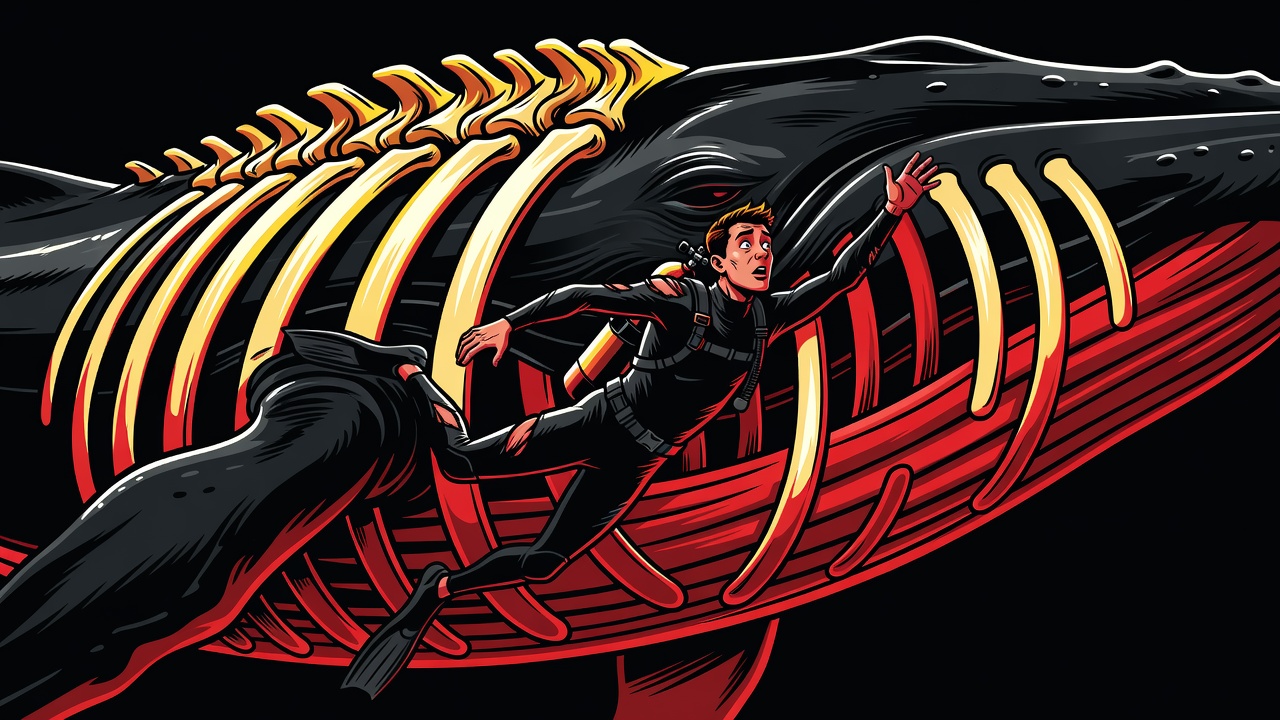
Instead, Jay gets caught in the middle of a sperm whale’s attempt to eat a squid. Nature does what nature does. Jay gets swallowed, and suddenly this becomes 127 Hours minus 126 hours, with the remaining hour spent inside a whale.
That survival premise is still fantastic. It is the reason the book worked, and it is the reason the movie works for as long as it does.
The sequence where Jay is swallowed is brutal and intense. If your particular phobia is being eaten alive, congratulations: this movie has prepared a personalized nightmare for you. The CGI is strong, and the sound design does a lot of the heavy lifting. The whale’s echolocation becomes a physical thing. You don’t just hear it. You feel trapped inside it with him.
This is one of those movies that benefits from a theater with a good sound system. The images are impressive, but the sound is what makes the experience uncomfortable.
The film also makes a smart adaptation choice with the whale’s stomach. In the book, it felt cramped enough that I kept wondering how anyone would film it without Jay spending the entire movie folded into a corner. The movie gives him more room to move around.
Ironically, the stomach has more room to breathe on screen.
That was the right call. A movie cannot simply reproduce every limitation of a novel and expect the audience to have a good time.
Austin Abrams gets trapped with the mouthpiece
Austin Abrams is solid throughout the movie. The problem is that his character has to keep a breathing mouthpiece in his mouth for much of the story. That makes sense within the situation, but it creates an obvious performance problem.
In the book, Jay’s inner monologue can carry the emotional weight. The reader has direct access to his fear, confusion, memories, and calculations. On screen, the film has to find another way to let us inside his head.
The solution is to let him talk with the mouthpiece in.
You know how your mother told you not to talk with your mouth full? Whalefall demonstrates why.
The result is strange. Jay is in an impossible survival situation, but he sometimes sounds like he is recording a guided meditation from inside a fish tank. It weakens the physical reality of the scene, especially when the movie wants the audience to feel every breath.
The flashbacks are more successful. Jay remembers moments with his father, and those memories occasionally give him the idea he needs to survive. A piece of information from the past becomes a tool in the present. That structure works because the flashbacks are doing more than explaining the backstory.
Josh Brolin is also good as Mick, even when the character is being an absolute nightmare. The flashbacks between Mick and Jay give the movie its emotional center, at least in theory.
The trouble is that the film keeps insisting the father-son relationship is more powerful than what it has actually shown us.
The drama gets swallowed
The survival material is direct. Jay needs air. He needs to escape. He has limited time, limited options, and a whale’s digestive system working against him.
The father-son material is much less disciplined.
The movie clearly wants this to become a story about grief, resentment, forgiveness, and the impossible need for a son to understand his father. That is a perfectly reasonable direction. The problem is that Whalefall starts making huge emotional and thematic demands without doing enough work to earn them.
By the final act, the movie gets very strange. I mean that as both a warning and a compliment.
The book is strange too, but prose gives the reader room to build a mental image that makes the absurdity easier to accept. The movie has to put everything on screen. That means we get surreal visual choices, including cheesy infrared whale imagery that made me wonder whether Jay had escaped into a different movie entirely.
The father-son material also starts pushing toward a kind of spiritual reconciliation that never fully lands. The film wants the relationship to feel mythic. Instead, it sometimes feels like the screenplay is pointing at the emotional meaning and waiting for us to applaud.
This is where the movie loses a lot of its audience. The opening acts are compelling because the problem is clear and immediate. Then the story starts explaining what the whale, the ocean, the father, and the son are supposed to represent.
I understood the intention. I just stopped feeling it.
The verdict
Whalefall is a strong survival movie trapped inside a less convincing family drama.
The whale attack is excellent. The production design is effective. The sound work is terrific. Austin Abrams gives a committed performance under the awkward circumstances, and Josh Brolin brings enough weight to the flashbacks to make the relationship worth watching.
But the film cannot quite complete the emotional journey it starts. It has the strange parts of the book, the heavy symbolism, and the big father-son reconciliation. It does not have the same ability to make all of that feel natural.
The first two-thirds are genuinely gripping. Then the movie starts trying to turn a boy inside a whale into a grand statement about fathers, sons, death, and forgiveness. That is a lot to ask from a story already dealing with a teenager trapped in a digestive tract.
I would have cut at least fifteen minutes, tightened the final act, and trusted the survival story more. The movie did not need to explain every feeling it had.
Whalefall is pretty awesome until it isn’t. I would wait for streaming, watch the first two-thirds, and decide for yourself whether you want to keep swimming.
Subscribe to Game Pilled: https://www.youtube.com/@GamePilledBlog
Join the Based New Wave!