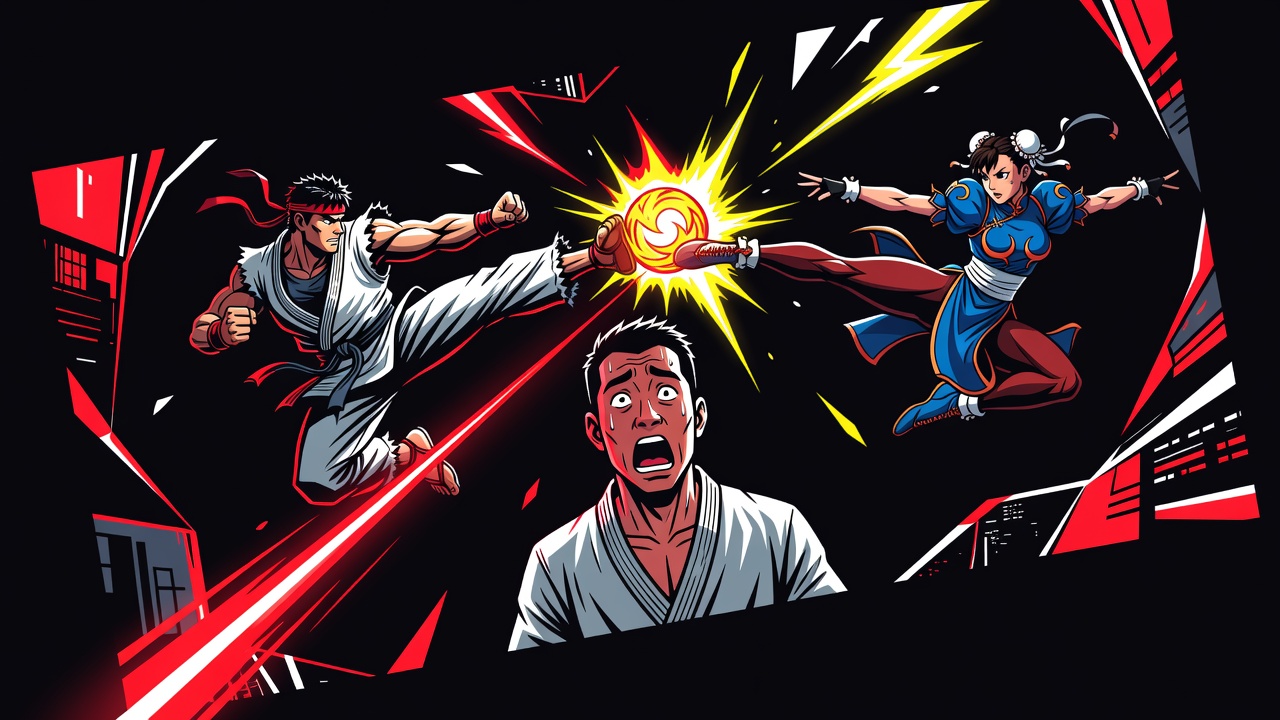
Street Fighter (2026) Review: A Mess With Good Fights
I wanted to like this movie. I really did. Street Fighter II is one of those games that does not need much help getting me excited. Give me the character entrances, the stage music, a few ridiculous special moves, and I’m already halfway there.
Unfortunately, this movie keeps reminding me that nostalgia is not a substitute for a screenplay.
The 2026 Street Fighter is loosely built around Street Fighter II, which is the correct choice. When people say “Street Fighter,” they usually mean Street Fighter II. Yes, the original game existed. Yes, Third Strike and Alpha 3 are arguably better games. But this is the one with the lineup, the tournament, the rivalries, and the cultural footprint.
The film knows that. It also knows there are too many characters, too many subplots, and too many pieces of lore competing for attention. So it centers the story on Ken, Ryu, and Chun-Li.
That part works.
Ken and Ryu carry the movie
Ken and Ryu are the heart of this version, and the actors playing them understand what makes those characters work. Ryu is the honorable fighter with something darker buried inside him. Ken is the more flamboyant martial artist who has drifted toward celebrity and spectacle, then has to figure out what happened to his sense of purpose.
Ken is exaggerated, but the exaggeration fits the movie. Ryu has the stoicism, the discipline, and the suggestion that the same power making him stronger could also destroy him. Their relationship gives the film its strongest emotional thread.
Chun-Li fits into that story well enough, too. The three of them feel like actual people moving through the same plot, which is more than I can say for several of the other characters.
The problem is that the movie keeps building toward a proper tournament and then wandering away from it. We get matchups, entrances, and hints of the fights we came to see. Then the film cuts away as if it has somewhere more important to be.
There’s a recurring joke where Eric Andre reacts to a fight like a commentator who just learned the match is over. “That was crazy. Who’s next?” That is basically the audience’s experience. I wanted to see the fights. The movie wanted to discuss the fights after they happened.
The tournament is mostly decoration
A Street Fighter tournament should be the engine of the movie. Instead, it’s a framework holding together a bunch of unrelated scenes.
Characters appear for a moment, demonstrate that they look like their game counterparts, and then disappear. Vega is a particularly strange example. He has the costume and the claws, but almost no personality. In the 1994 movie, Vega was a memorable character. Here, he feels like somebody wandered in from the Spirit Halloween display and forgot to leave.
Guile has the haircut. That’s about it.
I understand wanting visual accuracy. I enjoy seeing the costumes, poses, and recognizable details. But accuracy is only the first step. A character can look exactly like the game and still feel completely empty.
This movie repeatedly gives me that experience. I’ll see a character and think, “That’s a perfect translation of the design.” Then the character opens their mouth and reminds me that a Halloween costume is not a personality.
The tone keeps changing its mind
The biggest problem is the movie’s inability to decide what it wants to be.
When we first arrive at M. Bison’s laboratory, I thought I understood the assignment. It looked like a cheesy 1990s action movie. The production design was loud, the villain’s lair was ridiculous, and the whole thing seemed ready to embrace the silliness.
I’m fine with that. A live-action Street Fighter movie should probably be a little ridiculous.
But the movie doesn’t commit. It moves from goofy B-movie nonsense to sincere martial arts drama, then to broad comedy, then to action spectacle. Those modes can coexist, but they need a common rhythm. Here, they feel like different movies fighting over the same runtime.
The jokes don’t always land because the film keeps stopping to make sure we understand that it is making a joke. The dramatic scenes have trouble carrying weight because they are surrounded by material that treats everything as a punchline.
A 1990s throwback should feel like a movie from the 1990s. It should not feel like a modern movie wearing a T-shirt that says, “Remember the 1990s?”
That distinction matters.
Bison is a major misfire
David Dastmalchian is a talented actor, and it’s clear that he put real thought into Bison. This version treats the character as a cult leader and attempts to build an origin around why people would follow him.
That is an interesting idea. It simply belongs in a movie willing to explore it.
Instead, Bison is trapped between a serious character study and a Raul Julia impression. The movie even reaches for the famous “But for me, it was Tuesday” energy, which only makes the comparison harder to avoid.
Raul Julia’s Bison worked because he committed completely. He knew the material was absurd, so he played every line with total conviction. This version keeps looking over its shoulder to see whether the audience is laughing.
That uncertainty weakens the character. Bison does not need to be realistic, but he does need to be focused.
The animated scenes are the best scenes
The strangest choice in the movie is also the one that works best: the animated sequences.
The film uses animation for exposition, flashbacks, and pieces of setup. Every time one of those scenes started, I found myself thinking, “Why isn’t the whole movie this?”
The animated material understands movement and exaggeration in a way the live-action scenes often do not. It captures the heightened quality of Street Fighter without forcing real actors to pretend that every strange pose is natural.
The live-action fights can be fun, too. They are over the top, but once the film establishes that this is its reality, I’m willing to go along with it. When the action is allowed to breathe, the movie delivers the kind of ridiculous spectacle I wanted.
The references are fun. The stage music is fun. Hearing those familiar themes before a fight still works because Street Fighter II music has an unfair advantage over almost everything else.
Those moments feel made by people who know the games.
That’s why the rest of the movie is so frustrating.
Final take
This is the most faithful live-action Street Fighter movie we’ve gotten, which is a very low bar and still not enough.
The film understands the characters visually. It gets more of the lore right. Ken, Ryu, and Chun-Li give it a workable center. The fights occasionally hit, the animated sequences are genuinely good, and the soundtrack knows exactly when to press the nostalgia button.
But the plot is overstuffed, the pacing is uneven, the comedy is unreliable, and the tournament structure is treated like a suggestion. The movie needed to be shorter and more focused, or longer and willing to develop its characters. Right now, it sits in the worst possible middle ground.
I had fun with parts of Street Fighter. I also spent a lot of time wondering why the movie kept teasing the thing I actually came to watch.
Verdict: 5/10.
Remember: getting the costume right is not the same as getting the character right.
Subscribe to Game Pilled: https://www.youtube.com/@GamePilledBlog
Join the Based New Wave!