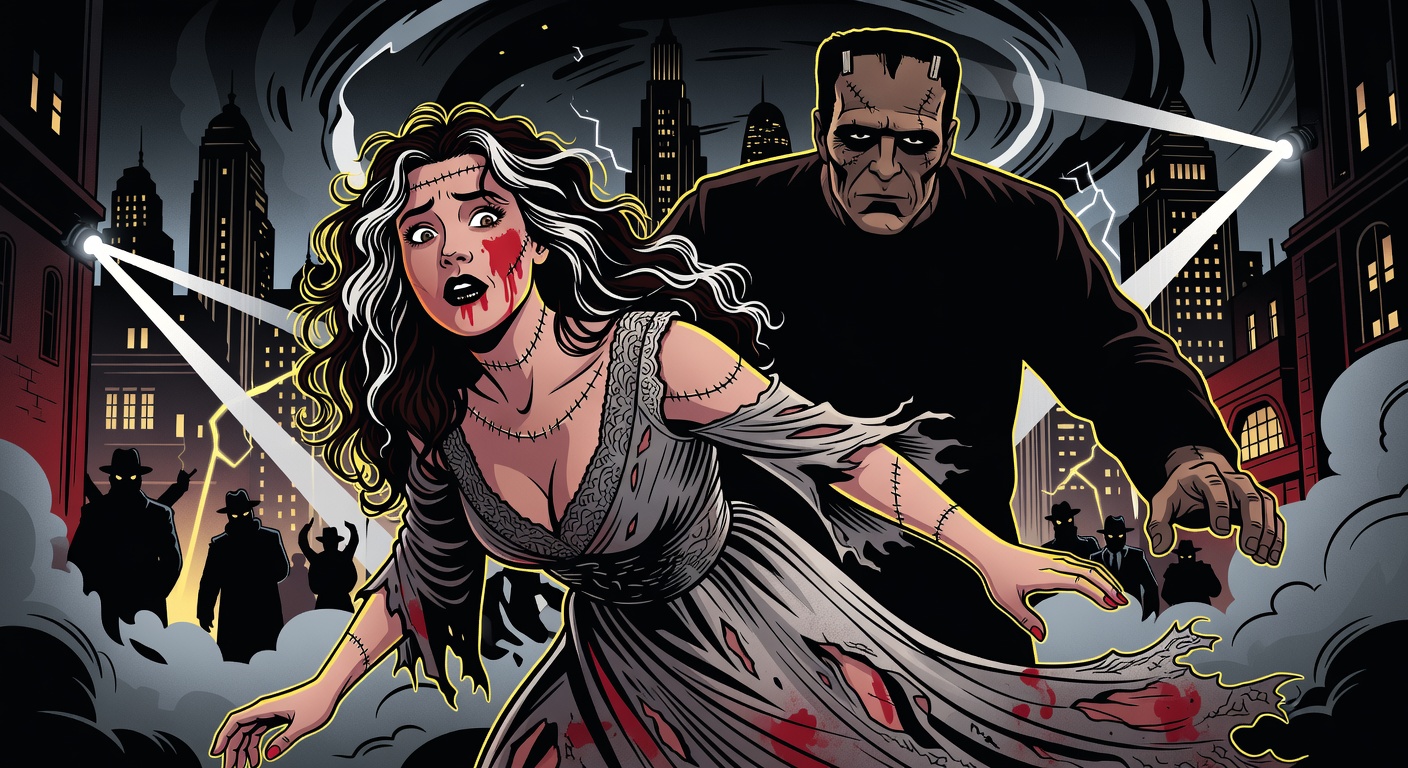
The Bride! - Movie Review
I went into The Bride! wanting to like it more than I expected to. I respect a movie that takes a wild tonal risk, and this one definitely does that—hard, repeatedly, and with a brass band behind it. This is a chaotic riff on Bride of Frankenstein that mashes monster melodrama, lovers-on-the-run energy, feminist allegory, and musical-adjacent fever dream staging into one very loud package.
For a while, I was in.
Then the second half happened, and the movie started tripping over its own ideas like it forgot which monster it wanted me to root for.
What worked better than it had any right to
Let’s start fair: the performances carry this thing farther than the script deserves.
Christian Bale (as Frankenstein/“Frankie”) is doing real character work here, not just prestige cosplay under makeup. He plays the creature as emotionally stunted but volatile—old in years, young in impulse. The speech rhythms, the sudden guttural outbursts, the physical frustration when he can’t articulate what he feels—it all tracks. It feels lived in.
But this is Jesse Buckley’s movie. Full stop.
Her Bride performance has a built-in risk that should have failed: the character periodically slips into another register, another voice, another personality pulse, as if she’s being spoken through. In lesser hands, that kind of choice looks like a gimmick pasted onto the film-school thesis. Buckley makes it feel eerie, wounded, and weirdly coherent. She sells the tonal whiplash so well I stopped resisting it and just followed her.
That’s not easy. The movie asks a lot of trust from the audience, and she earns most of it.
The movie’s style: bold when focused, sloppy when not
Visually and tonally, this thing plays like someone sprayed Baz Luhrmann all over a Gothic crime story. Sometimes that’s a compliment. Sometimes it’s not.
There are sequences—especially in the first half—where the heightened style actually builds tension instead of killing it. A dance-heavy set piece, for example, isn’t just there to look quirky for trailer clips. It escalates dread. You can feel trouble coming before it arrives. That’s good filmmaking.
The problem is consistency. The Bride! keeps introducing new side routes and visual flourishes without deciding which ones matter. So what starts as expressive eventually feels scattershot. The film doesn’t run out of energy. It runs out of discipline.
Where it starts to fall apart
At some point, the core relationship gets diluted by side plots that feel less like story and more like runtime padding.
We spend too long with detective threads that begin as useful “normal world” framing and end as narrative drift. There’s also a mob-boss tangent with gendered brutality baked into it that looks like it should connect to the film’s central thesis—but mostly just sits there like a half-written argument. You can remove large chunks of this material and lose very little emotional payoff.
And that’s the key issue: payoff.
The movie keeps setting pieces on the board, then either rushing past them or dropping them altogether. Themes appear, flare up, then vanish. Character arcs start to form, then stall. By the final stretch, I wasn’t asking “what happens next?” I was asking “which version of this movie am I watching now?”
The feminism question (and why the discourse is partly right, partly lazy)
A lot of reaction online has already reduced this to “woke agenda movie bad.” That critique is too blunt to be useful, but it’s not coming from nowhere.
The film absolutely foregrounds female rage, voice, and retaliation in ways that are meant to provoke. Fine. No issue there. But message-heavy storytelling still has to obey story logic. When thematic moments are inserted without development or consequences, audiences feel lectured at, not immersed with. That’s where the backlash is finding oxygen.
Here’s my take: the problem isn’t that the movie has a political or gendered lens. The problem is that it’s structurally messy enough to make that lens feel louder than the character logic beneath it.
When theme outruns causality, even sympathetic viewers start checking out.
Pacing and repetition: death by accumulation
The middle-to-late section suffers from repetition in both tone and incident. Threat patterns replay. Character beats loop. The same point is made again with slightly different staging. It creates that specific kind of fatigue where a movie feels longer than its runtime.
And this project did not need to feel longer.
You can feel a tighter, meaner cut trapped inside this film—one that keeps the fever-dream romance and trims the detours. That cut might have been genuinely great. The one we got is intermittently great and frequently overbuilt.
Is it the “monster movie Joker wanted to be”?
People are going to keep making that comparison, and the movie practically invites it with its theatrical nihilism, social contagion motifs, and stylized unrest imagery.
I’ll say this: The Bride! is more interesting than a lot of studio-safe prestige slop because it actually risks embarrassment. It’s trying something. But ambition doesn’t exempt execution. By the finish line, this feels less like one sharp thesis and more like cinematic spray-and-pray: fire at every wall and hope enough bullets hit art.
Some do.
Plenty don’t.
Final take
I liked this more than I disliked it, but I didn’t love it—and that gap is the whole review.
If you’re in for performances, heightened mood, and a messy auteur swing, there’s material here worth seeing. Jesse Buckley and Christian Bale give this film a pulse even when the writing loses its map. If you need clean narrative architecture, disciplined side arcs, and airtight thematic follow-through, this is going to frustrate you fast.
My verdict: worth a stream, not a must-pay theatrical ticket for most people.
Because: a monster romance can be ugly, chaotic, and confrontational—that’s the point. But it still has to be a story, not a mood board with blood on it.
Subscribe to Game Pilled: https://www.youtube.com/@GamePilledBlog
Join the Based New Wave!