The End of Oak Street Review: Dinosaur Apocalypse, Suburban Idiocy
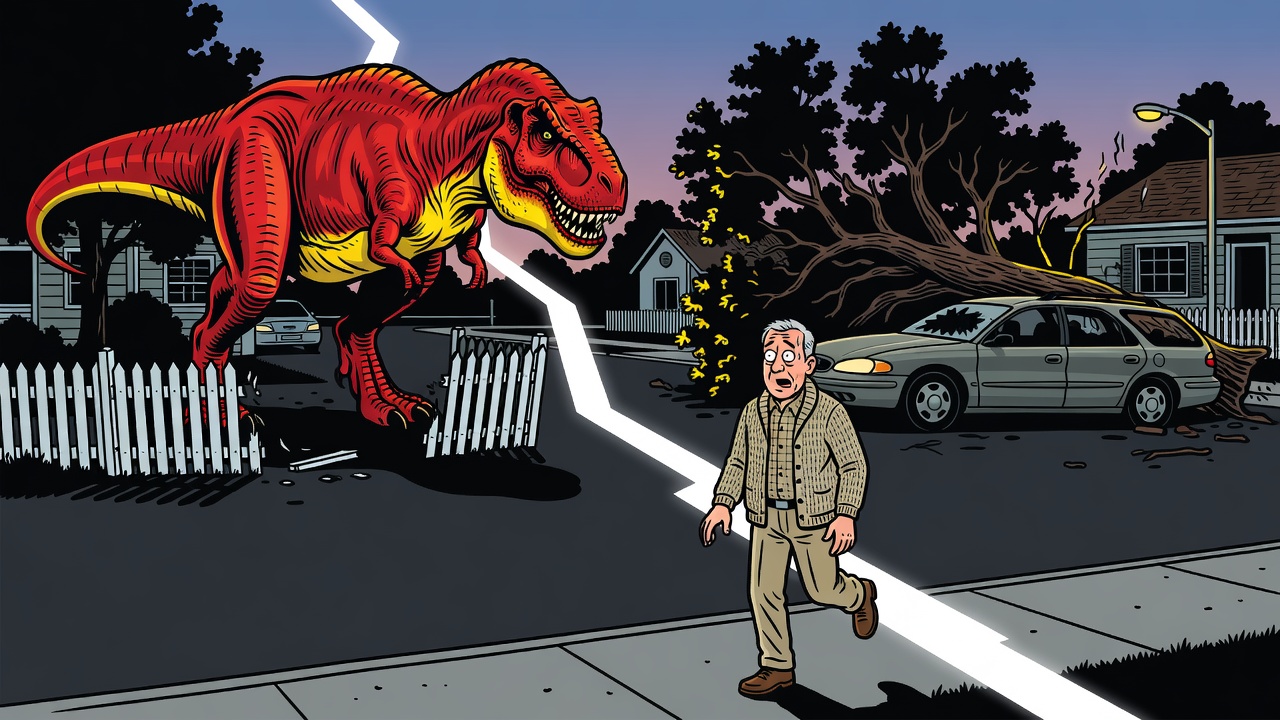
There is a very simple pitch hiding inside The End of Oak Street: what if a quiet 1980s suburb suddenly got hit with a dinosaur apocalypse?
That should work. Honestly, it should be hard to make that boring. Dinosaurs in the neighborhood. Families trapped in their homes. The food is running out. The street is no longer safe. Your pleasant little cul-de-sac has turned into a buffet line with vinyl siding.
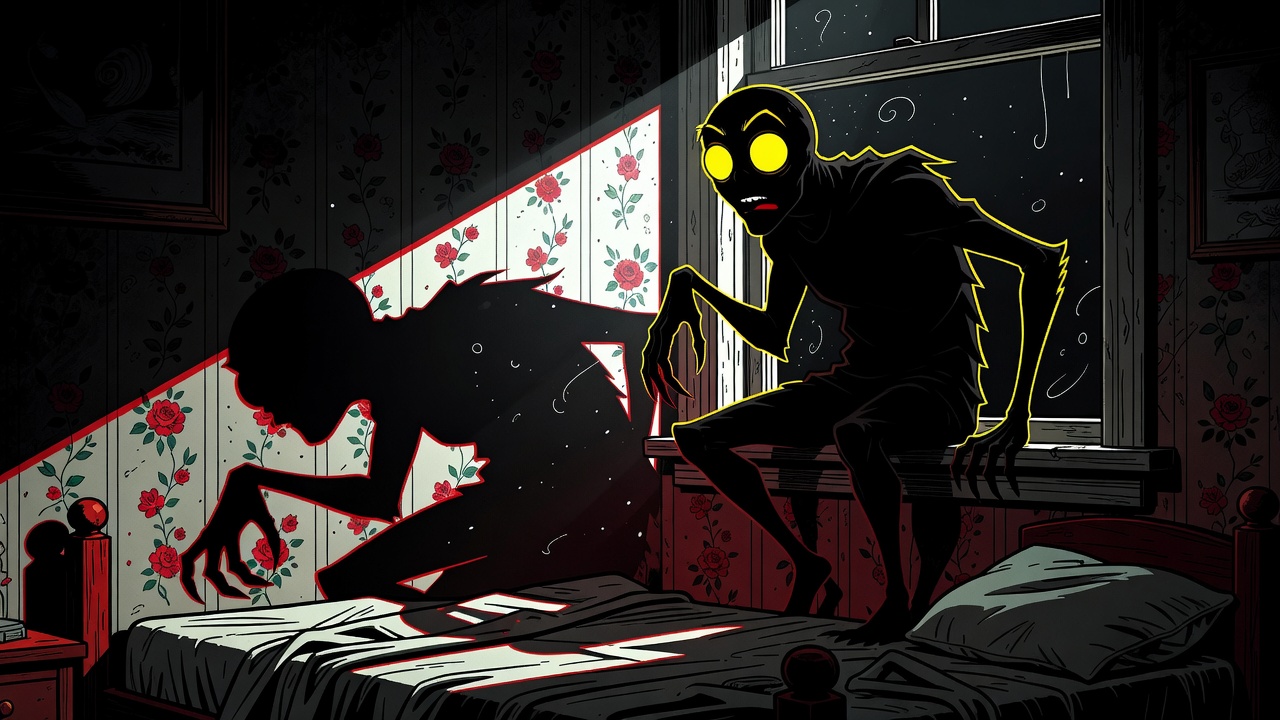
And for a while, the movie understands the assignment. It has that old sci-fi anthology feeling, where something impossible has happened, nobody fully understands it yet, and the normal world suddenly feels hostile. The best parts of the movie are not the big dinosaur moments. They are the early moments where you hear something outside, see people reacting before you see the threat, and feel the town slowly realizing that the rules of reality have changed.
Then the movie has to become a feature film.
That is where the problems start.
A Great Setup Looking For A Better Movie
Written and directed by David Robert Mitchell, The End of Oak Street stars Anne Hathaway and Ewan McGregor as a married couple trying to keep their family alive after a blinding anomaly somehow brings dinosaurs into their suburban town.
The setup is easily the strongest part. The movie has a very clear “less is more” stretch early on, and it works. You do not need a dinosaur stomping directly into frame every five seconds to create tension. Sometimes the sound is enough. Sometimes the empty street is enough. Sometimes one neighbor getting dragged into the unknown does more than a whole pile of CGI.
The dinosaurs themselves are more birdlike than the classic theme-park monsters most audiences grew up with. Feathers, strange movement, a slightly uglier biological texture. I actually respect the attempt to make them feel a little less like the same old movie dinosaurs we have been watching for decades.
The problem is that once the movie starts showing more, the spell starts breaking. The effects and creature work are uneven, and when your entire movie is built around dinosaurs invading suburbia, the dinosaurs cannot feel like the least reliable part of the experience. Some of the carnage is fun. Some of it looks cheap. Some of it feels like the movie is hoping the premise will do the heavy lifting.
It does not.
Anne Hathaway Deserves Better Survivors
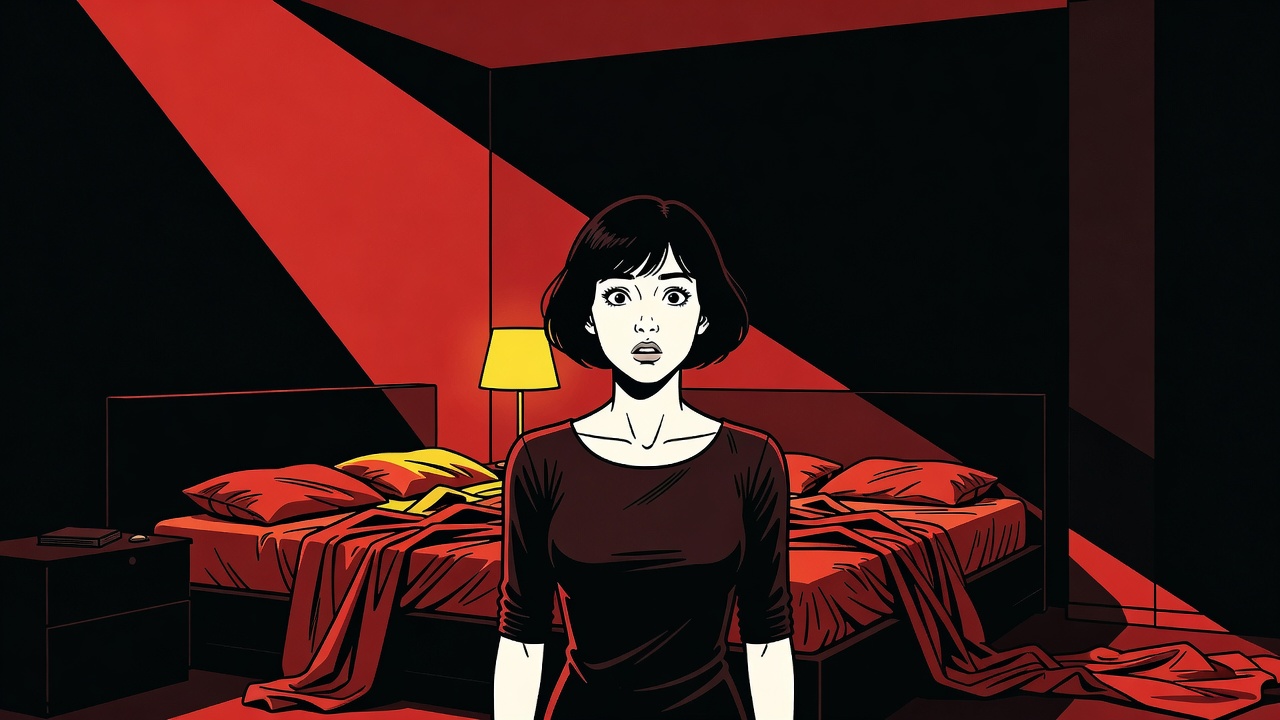
Anne Hathaway is the standout here, and that is not surprising. She is good. She knows how to anchor a scene, sell fear without overplaying it, and make a survival problem feel immediate.
But there is another question lurking underneath that praise: is she standing out because the role is great, or because she is the only character in the movie with a pulse?
Because the family dynamic is rough.
Ewan McGregor’s husband character is written like a wet blanket with a mortgage. The family is trapped during a dinosaur outbreak, food is becoming an obvious problem, and Hathaway’s character is the one saying, essentially, “We need to move, or we are going to die here.” His response is mostly variations of “No, outside is dangerous, and I simply choose not to believe starvation exists.”
That is not a character. That is a sofa with anxiety.
There is a version of this where the cowardly or passive father gets an actual arc. Maybe he freezes under pressure, then slowly steps up. Maybe the marriage cracks because crisis reveals who was already carrying the family. Maybe the kids have to learn which parent is actually seeing reality clearly. Any of that could have worked.
Instead, the movie mostly makes Hathaway look like a single mother of three, one of whom happens to be her adult husband.
That drains the survival drama. I do not need every character to be a genius. Horror and thriller characters are allowed to make mistakes, especially under panic. But there is a difference between believable fear and watching people repeatedly behave like they have never heard of consequences.
The Tone Keeps Tripping Over Itself
The other big issue is tone.
Sometimes The End of Oak Street plays like horror. Sometimes it wants to be a sci-fi thriller. Sometimes it drifts into comedy. There are lines and moments clearly meant to get laughs, and some of them do. Then there are scenes where the audience laughs and I am pretty sure the movie wanted us to be horrified.
That is a dangerous place to be.
A dinosaur apocalypse in suburbia can absolutely have humor. In fact, it probably should. The absurdity is baked in. But the humor has to sharpen the tension, not puncture it. When the movie wants me scared in one moment and then accidentally makes me laugh in the next, I stop worrying about the family and start noticing the machinery.
The movie also has a habit of explaining things that the filmmaking already communicated. There is a strong moment after the anomaly where the sound design makes you feel the pressure and distortion in the characters’ ears. It is effective. You can almost feel the urge to pop your own ears.
Then the characters start spelling it out.
That kind of thing makes the movie feel nervous about trusting the audience. The audio already did the job. Let it do the job. When characters turn around and explain the sensation we are currently experiencing through the sound mix, it stops being immersive and starts feeling like the movie is reading its own stage directions aloud.
The Idiot Plot Has Dinosaurs Now
A survival movie lives or dies on behavior. Not perfect behavior. Human behavior.
This is where The End of Oak Street gets exhausting.
There are too many scenes where people seem to forget that they are living inside an active predator zone. Characters stand around talking with barely any awareness of their surroundings. Giant dinosaurs manage to sneak up on people with the grace of a ninja in a library. I do not need the full Jurassic Park water cup treatment every time something large approaches, but come on. If an allosaurus-sized problem is walking into your peripheral vision, maybe somebody should notice.
The movie also introduces a bully subplot involving one of the kids, and it feels like a deleted arc that somehow survived the edit. Early on, there is setup for this kid having a grudge. Later, there is a chase and tussle during the dinosaur disaster, which raises the obvious question: has this kid been asleep for several days?
There are carnivores outside. Civilization is falling apart. The neighborhood is no longer a neighborhood. It is a feeding ground. And this little genius is still trying to settle schoolyard business.
That could have gone somewhere. The bully and the family’s kid could have been forced to cooperate. Their dumb little feud could have been swallowed by a larger survival problem. They could have had an actual mini-arc.
Instead, the bully shows up, causes trouble, leaves, and the movie moves on like someone misplaced the rest of his pages.
The Movie Is Short, And Still Feels Stretched
At around 90 minutes, The End of Oak Street is the right length on paper. This is not a story that needs two and a half hours, three timelines, and a mythology binder.
But even at 90 minutes, it starts feeling repetitive.
Family hides. Family argues. Dinosaurs threaten. Someone makes a questionable decision. Repeat. There are some solid chase sequences, including one that genuinely wakes the movie up for a bit, but the overall rhythm never builds the way it should. The premise keeps promising escalation, while the script keeps circling the same family tension and the same survival beats.
That is why I keep coming back to the anthology comparison. As a tight hour of television, this could have been terrific. A strange town. A blinding anomaly. Suburban normalcy collapsing. Dinosaurs as the impossible intrusion. One family trying to survive until morning.
As a feature, it feels inflated.
Not huge. Not catastrophic. Just stretched past its natural size.
The Shyamalan Problem
The easiest way to describe The End of Oak Street is that it often feels like an M. Night Shyamalan movie, for better and worse.
You have ordinary people dealing with an extraordinary mystery. You have a high-concept event nobody can really explain. You have sincere family drama sitting next to awkward comedy. You have characters who do not always talk like people. You have decision-making that makes you stare at the screen and wonder if survival instincts were optional in 1982.
If someone walked out of this movie, having no idea who made it, and you told them it was Shyamalan, I think they would believe you immediately.
That is not automatically an insult. There is a reason those kinds of premises are compelling. The ordinary world cracking open is a strong hook. But the execution has to be disciplined. The characters have to feel specific. The tone has to hold. The mystery cannot be the only engine.
Here, the engine sputters.
Final Take
The End of Oak Street is not the worst movie of the year. It is too watchable for that, and there are enough decent dinosaur moments, strong sound choices, and eerie suburban images to keep it from being a total waste.
But it is one of the more disappointing movies of the year for me, because the premise is so obviously better than the movie built around it.
Anne Hathaway does what she can. The early tension works. The sound design has a few genuinely effective touches. Some of the dinosaur chaos is fun in the way dinosaur chaos is almost always fun.
The rest is a frustrating pile of thin characters, inconsistent tone, spotty spectacle, and survival decisions that make you wonder how this family lasted longer than the neighbors.
Verdict: The End of Oak Street is a decent anthology episode trapped inside a mediocre feature film.
Remember: if dinosaurs invade your town, maybe look around once in a while.
#TheEndOfOakStreet
Subscribe to Game Pilled: https://www.youtube.com/@GamePilledBlog
Join the Based New Wave!