Mutiny - Movie Review
Jason Statham does not technically play the same character in every movie.
I know this because lawyers exist, credits exist, and sometimes the character has a different job title. One week he is a beekeeper. Another week he is a mechanic. Now he is a driver/bodyguard/suspiciously capable man who ends up on a cargo ship full of people begging to be introduced to a fist.
But spiritually? Come on. We all know the truth. There is a Statham Cinematic Universe, and every new movie is just another declassified mission file from the life of the same bald British violence delivery system.
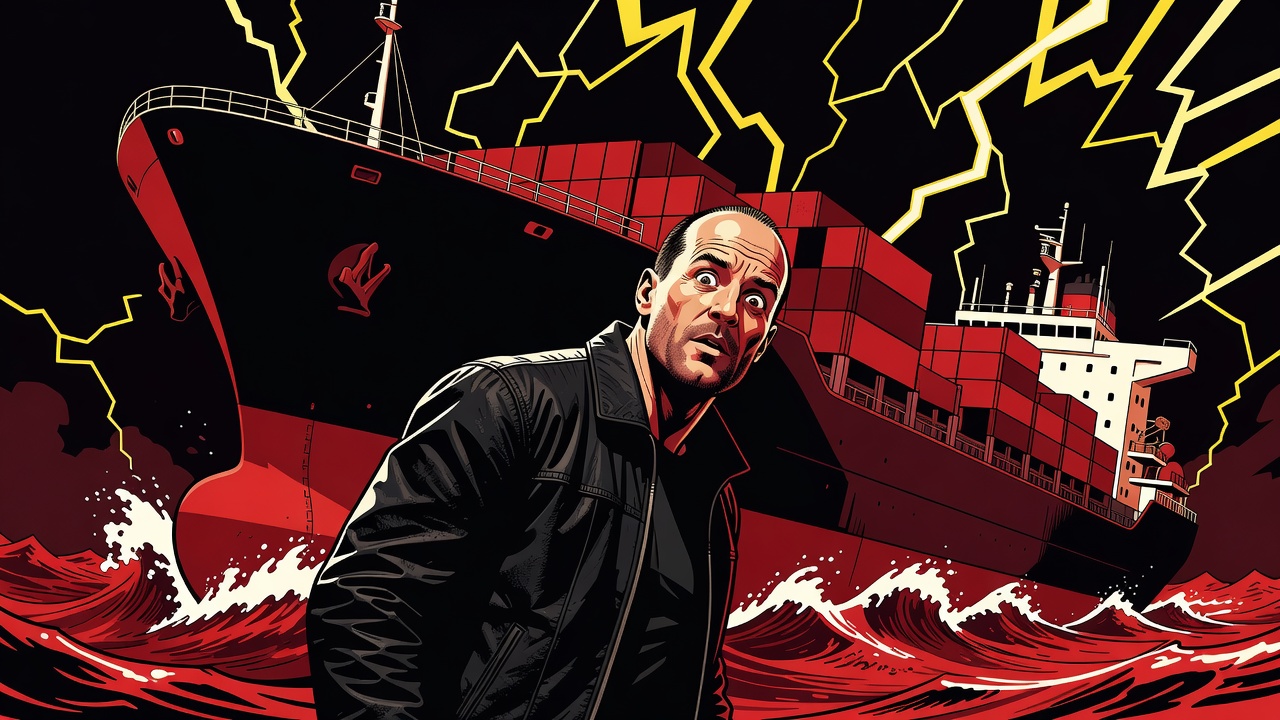
That brings us to Mutiny, a new Jason Statham action movie on a ship. If that sentence already told you everything you need to know, congratulations, you have seen movies before.
A very Statham situation
Mutiny is directed by Jean-Francois Richet, who also made Plane, that Gerard Butler throwback action movie that felt like it came out of a Blockbuster shelf in 1997 and somehow escaped into the 2020s.
That is basically the lane here too. Mutiny wants to be a lean, mean, 90s-style action picture. A tough guy. A confined setting. Some criminal scum. A rising body count. Maybe a bit of moral outrage to justify the carnage, because apparently even Jason Statham needs paperwork now.
The setup is more tangled than it needs to be. Statham plays a driver and apparent bodyguard for a wealthy businessman. The businessman gets murdered. Statham follows the trail, which eventually leads him to a ship, where he discovers that something even nastier is going on. Before long, he is working his way through the crew, climbing the ladder of disposable goons, and making the title feel increasingly literal.
Yes. It is a mutiny.
And when the movie remembers that this is why we showed up, it works.
The action knows the assignment
The good news is simple: when Mutiny gets moving, it is fun.
Statham still has that rare action-star quality where you believe the impact. He does not look like a man pretending to be dangerous. He looks like a man who has spent the last twenty years disappointed that doors, tables, hallways, and human cartilage keep getting in his way.
There are a few sequences here that have real snap. The movie does not drown you in nonstop action, which actually helps. When the fighting starts, it feels like the film has finally stopped explaining itself and started doing the thing it was built to do.
There is one hallway shootout that gets genuinely ridiculous. Guys keep appearing, getting shot, and then more guys appear in the same space like the ship is running on a villain respawn system. As a video game person, I have seen this before. This is basically Statham playing the tanker chapter of Metal Gear Solid 2, except Snake has been replaced by a man whose stealth strategy is "what if everyone else stopped being alive?"
Is it elegant? No.
Did I laugh? Yes.
Did I mind? Also no.
That is the deal with a movie like this. I do not need every henchman to have a rich inner life. I need the geography to mostly make sense, the punches to land, and the hero to look like he knows which end of a gun points at the problem. On that level, Mutiny clears the bar.
The plot keeps getting in its own way
The problem is everything around the action.
This should have been brutally simple. Statham gets on a ship. Statham finds something horrible. Bad men try to stop him. Statham rearranges the bad men. Credits.
Instead, Mutiny keeps adding strands. The dead businessman. The investigation. The support character played by Annabelle Wallis. The Coast Guard material. The wider criminal situation. The human trafficking angle. The movie keeps opening drawers when it should be locking us in a steel corridor and letting Statham clean house.
Some of this stuff is not bad in theory. A trafficking plot gives the story a darker moral engine. A ship setting can create real pressure. The supporting cast can help widen the stakes. But the film does not make those pieces feel essential. It makes them feel bolted on.
Worse, some of the surrounding character material lands exactly the way a lot of modern action filler lands: like a writer got nervous that a straightforward genre movie was not "about" enough. Audience chatter around the movie has already picked up on that, with complaints about agenda-coded side details and irrelevant character baggage cluttering what should have been a no-nonsense Statham vehicle. I get why that irritates people. In this kind of movie, every extra subplot has to earn its place. If it does not sharpen the threat, raise the tension, or make the hero's choices more interesting, it is just drag.
And Mutiny drags more than it should.
A sharper version is sitting right there
Here is the maddening part: the cleaner version of this movie is obvious.
You do not need the murdered businessman as the big emotional hook. You do not need half the setup. You could make Statham the new guy on the ship for one job. He stumbles onto people trapped in a container. The crew realizes he saw too much. Now he has to survive the ship, save the victims, and tear through the operation before it reaches port.
Done.
That is a movie.
It would probably be shorter, meaner, and more focused. It would also give the ship more presence. One of the reasons Die Hard works, and one of the reasons Under Siege works as a ship-bound riff on that formula, is that the location becomes the pressure cooker. You feel the walls closing in. You understand the space. Every hallway, deck, kitchen, bridge, and engine room becomes part of the game.
Mutiny has flashes of that, but it keeps cutting away to business it thinks is important. The result is a movie that sometimes feels like a crisp throwback action thriller and sometimes feels like a pile of streaming-era plot obligations wearing a tactical vest.
The 90s knew how to do this
There is a reason people keep reaching back to 90s action movies.
They were not always smart. Plenty of them were proudly stupid. But the good ones understood focus. You establish the hero. You establish the location. You establish the villain. Then you turn the movie into a series of escalating problems solved through competence, violence, and one-liners.
Mutiny wants that energy, but it also wants a more complicated conspiracy shape. That can work if the writing is tight. Here, it mostly makes the movie feel longer without making it feel bigger.
The villain side also could use more flavor. If you are making a throwback action movie, give me a villain who enjoys being evil in a memorable way. Give me someone with a smug little speech, a strange obsession, a ridiculous plan, anything. Statham is reliable, but he cannot be the only personality in the room. A movie like this needs someone across from him who feels worthy of being punched through furniture.
Instead, too much of the opposition feels like human scenery with guns.
So, is it worth watching?
If you want Jason Statham on a ship beating up criminals, Mutiny gives you that.
That sounds like faint praise, because it is. But it is also the honest appeal. There is pleasure in watching a movie deliver the exact generic promise on the poster. Statham is dependable. The action has some great bursts. The ship setting gives the movie enough texture to avoid feeling completely disposable.
But this is not the lean throwback it could have been. It is too busy, too padded, and too convinced that extra plot equals extra stakes. The more it explains, the less effective it gets.
For a 90s action throwback night, Mutiny might make the list. It will not be the best thing on that list. It may not even be close. But if the room is already in the mood for steel corridors, bad decisions, and Jason Statham doing Jason Statham things, you could do worse.
Verdict: Mutiny is fun when it shuts up and lets Statham take the ship. Unfortunately, it keeps remembering it has subplots.
Subscribe to Game Pilled: https://www.youtube.com/@GamePilledBlog
Join the Based New Wave!