The Brink of War - Movie Review
There is a certain kind of historical drama that sounds like homework until the right actors walk into the room. The Brink of War is very much that kind of movie. On paper, it is Ronald Reagan and Mikhail Gorbachev in Iceland, trying to claw the world back from the nuclear ledge through diplomacy, ego management, and the ancient art of not blinking first.
That is not exactly a pitch designed to get teenagers sprinting to the theater. It is the sort of movie a substitute teacher wheels out when the lesson plan has collapsed and everyone knows the next ninety minutes are going to smell faintly of laminated worksheets.
And yet, somehow, this one works.
The Setup
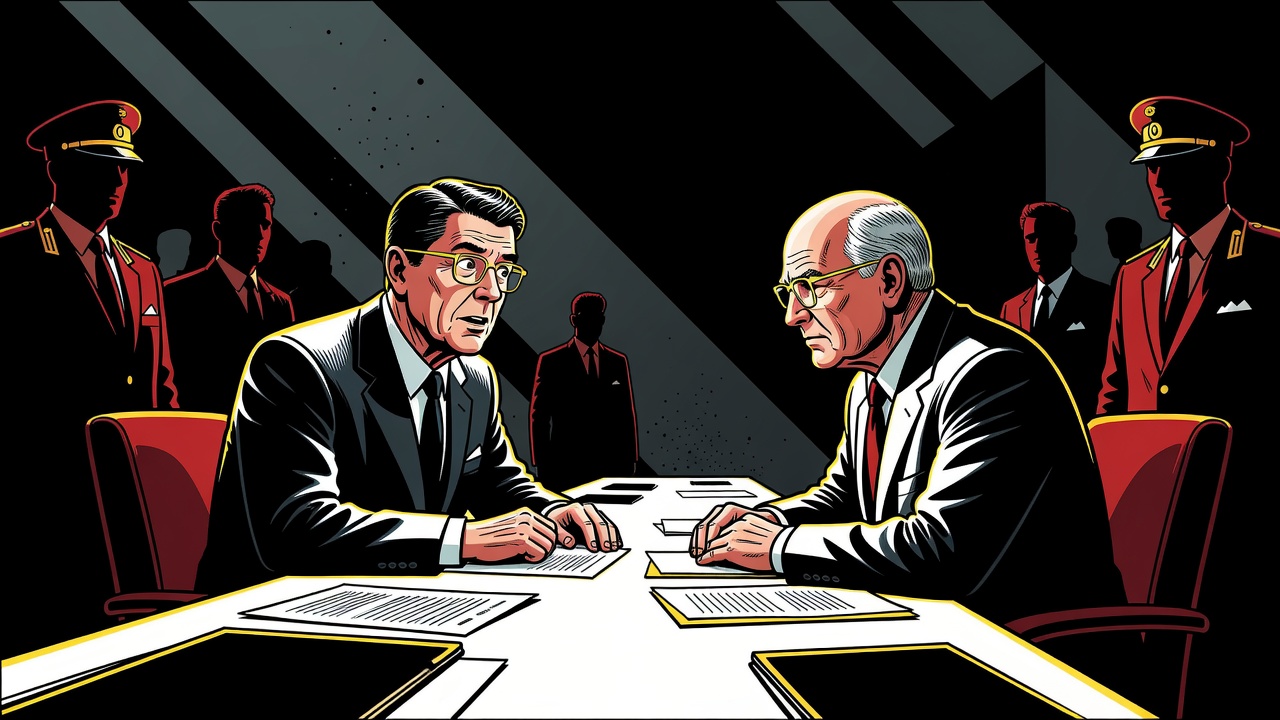
Written and directed by Michael Russell Gunn, The Brink of War centers on the 1986 Reykjavik Summit, with Jeff Daniels as Ronald Reagan and Jared Harris as Mikhail Gorbachev. The Cold War is still very cold. The United States and Soviet Union are sitting on mountains of nuclear weapons. The world is not ending yet, but everyone involved seems painfully aware that it could, if enough proud men make enough stupid choices in sequence.
The film knows its selling point: put Reagan and Gorbachev across from each other and let the pressure build. That is where it is strongest. Not in spectacle. Not in sweeping battlefield recreation. Not in prestige-drama wallpaper. Just two incompatible systems represented by two men who both believe they are being reasonable.
That is the delicious part. Neither man is written as a cartoon. Reagan is not simply the cowboy president with a smile and a missile shield. Gorbachev is not a stock Soviet villain with a folder full of grim threats. They are ideological opponents, yes, but the movie understands that peace negotiations are frightening precisely because they require serious people to make themselves vulnerable.
You do not get to disarm by winning every point. You get there by trusting the other side not to take the inch you just gave them and turn it into a knife.
The Performances
The big question hanging over this movie is Jeff Daniels as Reagan. I get the skepticism. Daniels is a strong actor, but he does not walk into frame and instantly read as Ronald Reagan in the lazy wax-museum sense. If you need the silhouette, the voice, the squint, and the presidential cosplay to do half the work for you, this casting may take a minute.
For me, that actually became less of a problem as the movie went on. Daniels is not giving a Vegas impression. He is playing the temperament: the firmness, the practiced charm, the old-performer confidence, and the strange mix of idealism and strategic stubbornness that made Reagan such a dangerous negotiator in both directions. The movie is better because Daniels does not disappear into latex. He has to act the man instead.
Jared Harris has the easier sell visually and the harder job dramatically. Gorbachev has to be wary, proud, calculating, humane, and exhausted without turning into the noble foreign statesman who exists only to make the American president look good. Harris gives the film its weight. You believe his Gorbachev wants peace, but you also believe he understands exactly how weak a leader can look when he appears too eager for it.
J.K. Simmons is also here, and he is, as usual, J.K. Simmons with institutional authority settings adjusted. That is not an insult. There are worse things a movie can do than deploy J.K. Simmons to walk into a scene and make everyone speak more efficiently.
The Pressure Cooker Works
The best version of The Brink of War is the one-room version. Reagan and Gorbachev trade positions. Progress appears. Progress evaporates. Someone makes a concession. Someone else hears a trap. The room warms up, then freezes again. It is not action in the conventional sense, but it has rhythm.
The film is smart enough to frame negotiation as a kind of psychological gambling. Every step forward raises the stakes. At a certain point, the question is not whether the leaders want a deal. It is whether either man can survive the political cost of making one.
That is where the movie finds real tension. Not in whether the audience knows history worked out better than it could have, but in watching how fragile “better than it could have” really was. Peace, in this version of events, is not a moral slogan. It is two men repeatedly choosing not to humiliate each other long enough to discover whether the impossible might be negotiable.
That is strong material, and Gunn’s direction mostly trusts it.
The Side Material Is Weaker
The movie stumbles when it wanders away from that central dynamic. The material involving the wives, the press perception, and the surrounding political atmosphere is not useless, but it is less compelling. I understand why it is there. A drama like this needs texture, and a leader’s private conversations can reveal the fears he would never admit across the negotiating table.
Still, every time the film leaves the core face-off, it feels like the air pressure drops. The personal scenes are not bad. They are just competing with the thing the movie clearly does best.
There is a version of The Brink of War that takes place almost entirely inside the negotiating space, with only brief interruptions from aides and advisors, and I suspect that version is sharper. More claustrophobic. More theatrical, maybe, but in the good way. Historical dramas often panic when they realize people are just talking. This one should have trusted the talking even more.
What It Gets Right
The movie’s best achievement is that it makes diplomacy feel dangerous without pretending it is glamorous. These are not superheroes. They are not spies. They are not morally pure chess masters calmly arranging history from above. They are political men representing vast systems, surrounded by pressure, trapped by doctrine, and forced to decide whether fear is a strategy or a prison.
That matters because a lot of modern political storytelling is allergic to complexity unless it can flatten it into a sermon. The Brink of War is not some radical act of nuance, but it does remember something many current films forget: enemies can still recognize stakes larger than their own vanity.
That does not make the film naive. If anything, it makes the situation scarier. Trust is not soft here. Trust is the hard part. Anyone can posture. Anyone can threaten. Anyone can go home and tell their side they refused to bend. The terrifying move is putting something real on the table and hoping the other man is not there to make you regret it.
The Verdict
The Brink of War is formulaic. You can feel the shape of it early: gain ground, lose ground, regain ground, stare meaningfully at the abyss. This is not a reinvention of the historical drama, and anyone allergic to boardroom tension may find themselves checking the runtime with the desperation of a man trapped in a mandatory training seminar.
But as a performance-driven negotiation film, it is solid. Daniels overcomes the initial “wait, that’s Reagan?” hurdle. Harris gives the movie its spine. The script finds enough friction in the summit itself to keep the stakes alive, even when the supporting arcs drag the focus sideways.
It is not the greatest anti-nuclear story ever told. It is not subtle enough to be a masterpiece or ruthless enough to be unforgettable. But it is a sturdy, serious-minded film about two leaders staring at catastrophe and deciding, however imperfectly, to keep talking.
For a movie that could have been cinematic NyQuil, that is a win.
Verdict: A talky but effective Cold War chamber drama, carried by strong central performances and a premise that gets more unsettling the longer you sit with it.
Subscribe to Game Pilled: https://www.youtube.com/@GamePilledBlog
Join the Based New Wave!